
Private-Domain + Enterprise Solution: use AI Agents to deliver customer service outcomes.
Private-domain operations have moved from customer reach to service delivery. Customers ask, chase, upload material, and confirm completion in WeChat and WeCom. Internal teams, sales, support, operations, and fulfillment partners coordinate around the same case. Aijia Customer Service connects automated reception, judgment, planning, progress, low-risk execution, high-risk human review, and evidence into one end-to-end AI-native service operations system.
Customer contact + actual executor + internal team + fulfillment partner
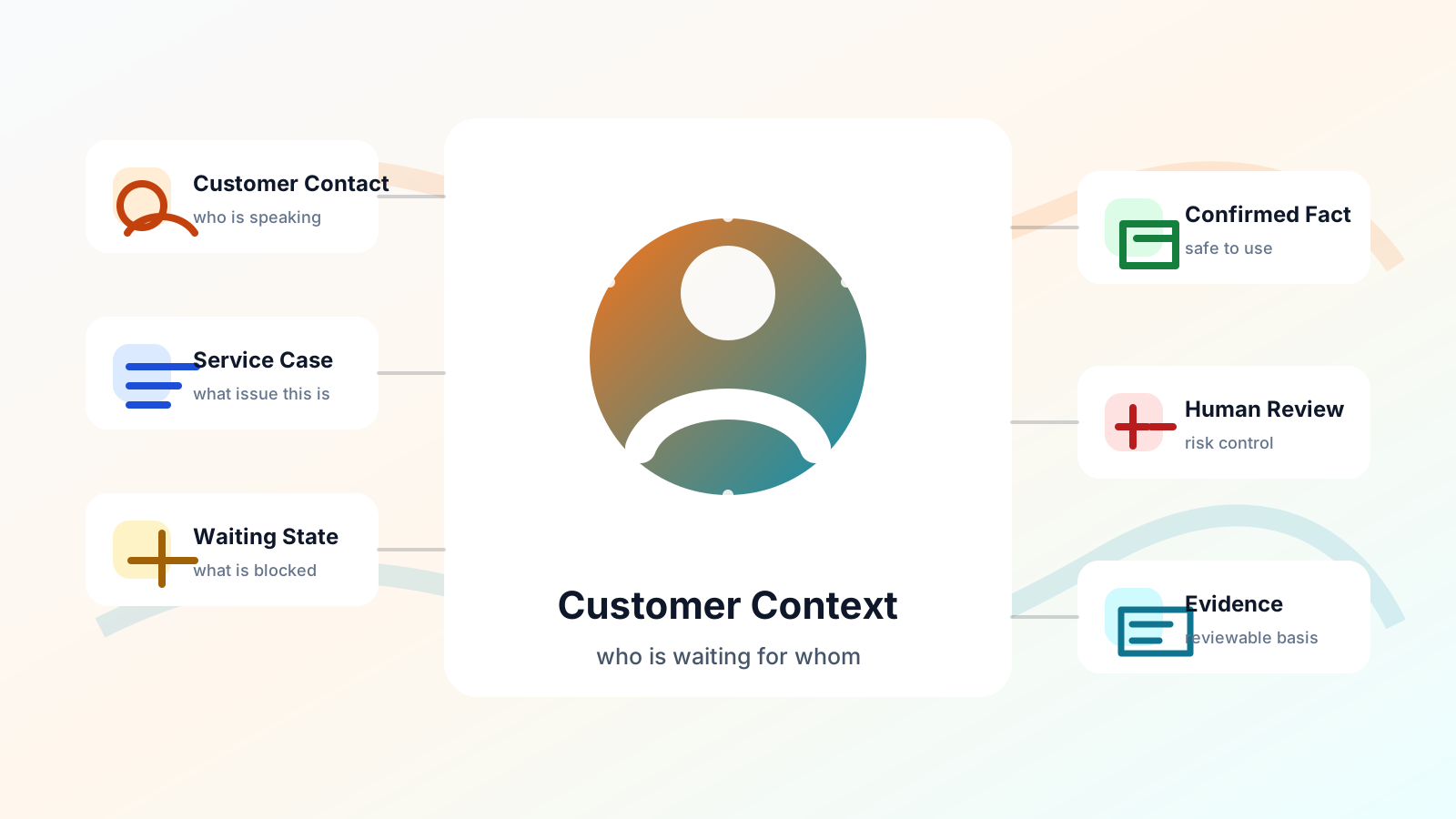
WeChat, WeCom, and customer groups have become customer relationship infrastructure. The next competition is service delivery closure.
Public market capabilities show that private-domain tools have long centered on acquisition, tags, group messaging, community SOPs, membership operations, and sales follow-up. Omnichannel support systems focus on unified intake, tickets, bots, and agent productivity. Global AI support products increasingly emphasize autonomous agents. Aijia Customer Service addresses the gap between them: in private-domain and enterprise service operations, customer identity, service cases, multi-role collaboration, executable actions, human review, and evidence need one automatically progressing commercial delivery chain.
Customer pools, tags, group messages, and campaigns are now baseline capabilities
Enterprises do not only need reach tools. They need an operations layer that moves customer requests toward service outcomes.
Customer contact, customer groups, and employee touchpoints preserve relationships
The platform solves customer connection and relationship management, but it does not decide how each service case should progress.
Intake, tickets, bots, and agent productivity keep improving
When service crosses customer groups, partner groups, back-office pages, and customer-side executors, traditional tickets often lose context and execution continuity.
Move from auto replies to automated understanding, progress, and execution
The next product category does not only answer customers. It organizes agent collaboration and governed execution around business outcomes.
Cover customer entrances across private domain, WeCom, social, ecommerce, and messaging
 WeChat
 WeCom
WeCom Douyin
 Xiaohongshu
 TikTok
 Instagram
 WhatsApp
 Amazon
 Shopee
 Shopify
Private-domain service breaks down not because teams are careless, but because service objects are not productized.
Customer messages, identity, service cases, partner requests, waiting states, actual executors, human review, and evidence are scattered across chats, spreadsheets, back offices, and individual memory. At scale, teams get missed follow-up, repeated chasing, wrong sending, and weak replay.
The same customer adds information in multiple places
A customer may ask in WeChat, upload material in a WeCom group, leave a website message, and confirm progress in a marketplace. Looking only by channel hides the active service case.
The contact is not always the actual executor
The person mentioned in a group may only coordinate, while the person who must confirm, authorize, submit, or report sits inside the customer organization.
Who is waiting for whom is not recorded by the system
Waiting for customer, partner, internal review, customer completion, or partner feedback leads to repeated chasing and missed work when it is not tracked.
Public groups, commitments, disputes, and compensation need review-before-send
If a product only optimizes auto-reply rate without review, takeover, pause, and evidence, it cannot carry high-value customer service.
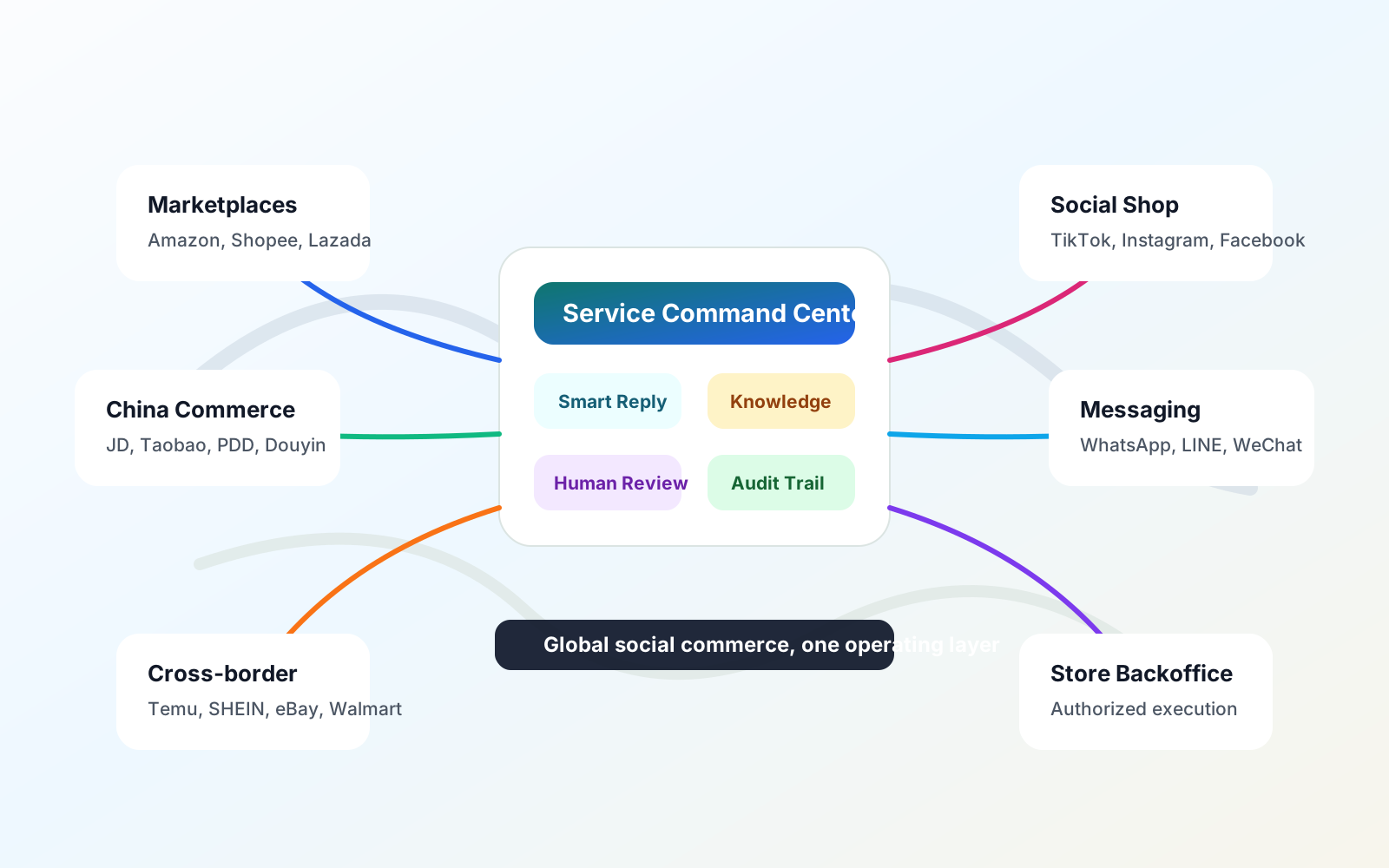
End-to-end AI Agent commercial delivery: automation is the foundation, agent collaboration is the leading difference.
Aijia Customer Service uses automation for repetitive actions, AI judgment to understand customers and cases, and multi-agent responsibility across reception, knowledge, service cases, partner collaboration, execution, review, and replay. Low-risk actions execute automatically. High-risk actions route to human review. It is not an AI chat box on top of a traditional system. It restructures enterprise service delivery into an agent product system that can run automatically, execute under governance, and scale.
Automated reception
Unify WeChat, WeCom, social, ecommerce, messaging, and web requests while establishing reception account, conversation, and identity boundaries.
Automated judgment
Identify customer identity, business conversation, service case, waiting object, partner request, and risk level.
Automated planning
Choose reply, material request, contact notification, actual executor wait, partner route, back-office verification, or review.
Automated execution
Run verification, reminders, state updates, customer-safe outreach, completion writeback, and evidence capture within authorization and policy.
The private-domain + enterprise solution is built from product capabilities that can launch independently.
Teams can start with one frequent customer group or service case, launch reception, identity, cases, review, and evidence, then expand into partner collaboration, more channels, and more business capabilities.
AI Agent Commercial Delivery System
Organize automation, AI understanding, multi-agent collaboration, low-risk execution, and high-risk review end to end.
AI Reception Workspace
Unify customer entrances, AI drafts, human takeover, reception accounts, and safe outbound.
Customer Identity and Context
Confirm customer, contact, conversation, and context scope before using private context.
Service Case Automation
Manage waiting states, next actions, completion feedback, and evidence trails.
WeCom Private-Domain Collaboration
Organize customer groups, contacts, actual executors, and internal teams into service collaboration.
Partner Fulfillment Collaboration
Turn partner requests into customer-facing service actions that can be understood, executed, and tracked.
Review and Evidence Governance
Review-before-send, human takeover, evidence trails, and QA replay.
AI Support Operations System
Unify knowledge operations, back-office verification, human review, QA, and multi-team governance.
Aijia Customer Service does not replace every tool. It integrates them at the private-domain service delivery layer.
Customer relationships, acquisition, omnichannel intake, marketing automation, tickets, and chatbots all matter. Aijia Customer Service's value is turning those entrances and actions into a service case closure layer where AI Agents are accountable for customer outcomes.
Once private-domain enters the AI Agent stage, competition shifts from reach efficiency to service delivery capability.
Enterprises should not compare only auto-reply rate. They should compare whether a system can identify customers, progress cases, execute low-risk actions, govern high-risk actions, preserve evidence, and replicate service capability.
Strength: end-to-end agentic delivery loop
Entrance, identity, business conversation, service case, waiting state, partner collaboration, execution action, human review, and evidence stay in one chain.
Weakness: it starts best with a clear process
It is not a one-click group automation tool. Teams must first define frequent processes, role relationships, risk boundaries, and review rules.
Opportunity: private-domain becomes enterprise service infrastructure
As customer groups carry pre-sale, after-sale, fulfillment, partner collaboration, and retention, enterprises shift from reach tools to AI service operations systems that deliver outcomes.
Threat: large vendors and SCRM products will add AI
But AI added to tags, group messaging, tickets, or single-turn Q&A still lacks one layer for identity, cases, waiting states, multi-agent collaboration, execution, and evidence.
Private-domain + enterprise AI Agents turn service capability into repeatable assets.
When identity, service cases, waiting states, review records, execution results, and evidence accumulate, private-domain stops being only a sales touchpoint and becomes a scalable service delivery system.
Frontline support reduces repeated follow-up
The system continuously maintains who the customer is, where the case is stuck, whether an actual executor must be coordinated, and what comes next.
Managers see service bottlenecks
Waiting for customer, partner, internal review, completed, or cancelled becomes visible without scrolling through group history.
Partner collaboration becomes stable
Partner requests become customer-safe wording and completion feedback returns to the service case, reducing missed relay and repeated chasing.
Enterprise experience scales
Frequent flows, customer wording, risk boundaries, QA findings, and evidence samples become reusable operating assets.
Rebuild private-domain service delivery with AI Agents.
Start with one frequent customer group or service flow. Establish reception, identity, case progress, waiting state, review, and evidence, then expand across teams and business lines.