AI Customer Service Evaluation Checklist: How to Choose a Support Execution Platform

Jun 2, 2026

The best AI customer service platform is not the one with the longest feature list. It is the one that fits your real support workflow without removing the controls your team needs.

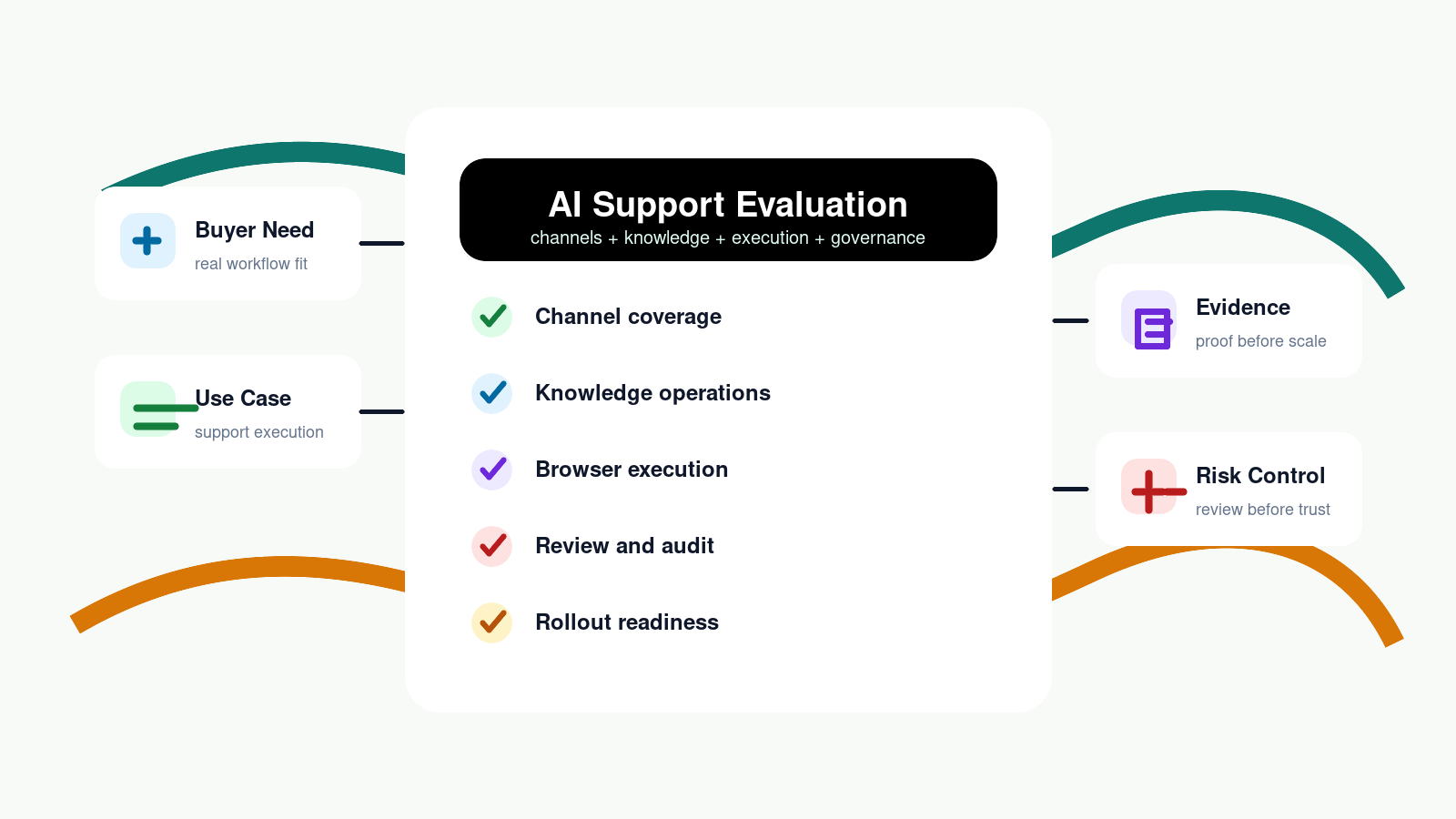
For ecommerce, social commerce, marketplace, IM, and private-domain operations, a useful evaluation should cover seven dimensions.

1. Channel Coverage

Ask which channels are supported today and which require custom work:

  • ecommerce marketplaces and seller centers;
  • short video and live commerce channels;
  • social DMs and comments;
  • WhatsApp, LINE, Messenger, WeChat, and WeCom;
  • email, web chat, and internal handoff channels.

Do not evaluate only the inbox. Evaluate whether the platform can connect conversation, order context, and back-office work.

2. Knowledge Operations

AI reply quality depends on knowledge quality. Check whether the system supports:

  • product facts, variants, compatibility, and contraindications;
  • logistics rules by region;
  • refund, return, warranty, and dispute policy;
  • campaign and coupon rules with expiration dates;
  • brand tone and channel-specific response formats;
  • review owners, versioning, and test questions.

If knowledge cannot be governed, AI will drift as policies change.

3. Execution Capability

Some tools only draft replies. Some can also help execute support work. For execution, ask:

  • Can it prepare or complete actions only inside authorized systems?
  • Can it use authorized back-office actions or support workflow automation when platform connectivity is incomplete?
  • Can it collect screenshots and before-after state?
  • Can it stop before high-risk submission?
  • Can it degrade gracefully when a page changes?

Execution is valuable only when it is bounded.

4. Human Review and Handoff

Review mode should be configurable. Check whether the platform can route:

  • refunds and compensation;
  • address or account changes;
  • dispute and complaint replies;
  • restricted product claims;
  • uncertain identity or order matching;
  • public messages with brand risk.

Humans should keep final control where the impact is high.

5. Evidence Trail

For every important case, the system should preserve:

  • original customer message;
  • retrieved knowledge;
  • AI draft and action plan;
  • screenshots or page evidence;
  • reviewer and approval result;
  • final reply;
  • case summary and tags.

Evidence is not only for compliance. It is how managers improve prompts, policies, and workflows.

6. Security and Platform Boundaries

Ask how the platform handles:

  • tenant, store, and role isolation;
  • credential and session boundaries;
  • platform terms and access controls;
  • emergency pause;
  • data retention and deletion;
  • logs for sensitive operations.

Avoid any vendor that presents bypassing platform controls as a product benefit.

7. Rollout Plan

Start narrow:

  1. low-risk FAQ and draft generation;
  2. order and logistics explanation;
  3. evidence collection;
  4. reviewed refund or dispute workflows;
  5. broader channel automation after QA.

The safest rollout proves value before expanding automation scope.

Where Aijia Customer Service Fits

Aijia Customer Service is designed for teams that need AI customer service to move beyond replies into governed execution. It is most relevant when support spans ecommerce platforms, social commerce, IM, and private-domain channels.

The product is not positioned as a generic helpdesk, a single-channel chatbot, or uncontrolled support workflow automation. It is a support execution platform that combines AI, knowledge operations, authorized back-office actions, human review, and evidence trail.

Aijia Customer Service Team

Aijia Customer Service Team

企业微信客服二维码

扫码联系客服